The expansive clays of the Eagle Ford Group underlie much of Dallas County, and their shrink-swell behavior has caused billions in foundation damage across North Texas. These soils can shift dramatically with seasonal moisture changes, which is why determining the Atterberg limits is not just a lab exercise here—it is essential risk management. Our testing follows ASTM D4318-17e1 precisely, measuring the liquid limit and plastic limit to calculate the plasticity index. In the Dallas-Fort Worth metroplex, a PI above 25 signals high expansion potential, a common finding in neighborhoods from Lakewood to Oak Cliff. We combine this data with grain size analysis to build a complete picture of the fines fraction and its behavior under varying moisture conditions.
In Dallas, a plasticity index over 25 is the red line—it separates manageable soil from a geohazard that demands engineered solutions.
Methodology and scope
Local considerations
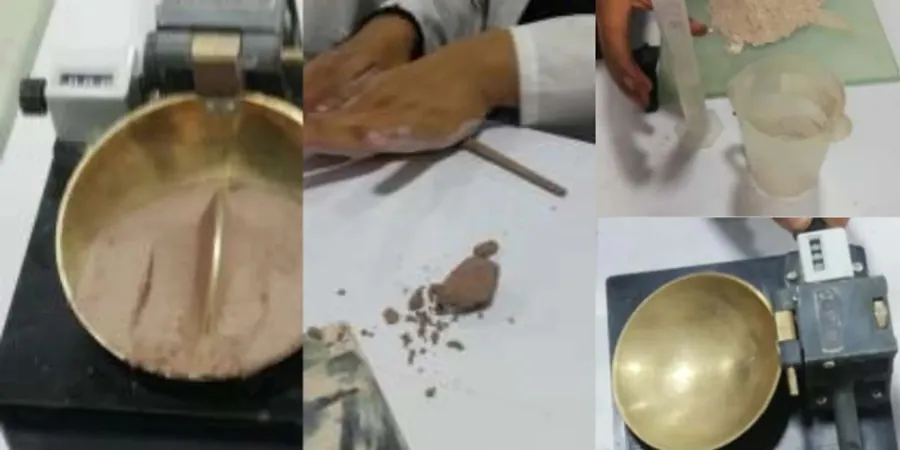
The technician sets the brass cup on the hard rubber base, adjusts the drop height to exactly 10 mm, and begins working the groove with the standard tool. Each blow count is logged—this is not automated work, it requires a trained eye and a steady hand. Skipping or rushing the procedure masks the true liquid limit. In Dallas, where clay seams can be thin and interbedded with weathered limestone, the sample must be fully representative. A poorly prepared specimen yields a liquid limit that is 10 to 15 points off, which cascades into foundation designs that underestimate swell pressure. The saturated clays of the Austin Chalk contact zone are particularly sensitive to this error. We run the full multipoint determination when the one-point method exceeds tolerance, because the cost of a repeat test is trivial next to the cost of a cracked slab.
Applicable standards
ASTM D4318-17e1, ASTM D2487-17, ASTM D2216-19
Associated technical services
Preliminary Atterberg Screen
Liquid limit, plastic limit, and PI on a single sample. Ideal for feasibility studies on raw land in Dallas, Ellis, or Collin counties. Results in 2 days.
Full Atterberg Profile with Gradation
Atterberg limits plus sieve and hydrometer analysis per ASTM D422/D6913. Used for final foundation design on expansive Eagle Ford clay sites.
Moisture-Density & Atterberg Package
Combines Atterberg limits with standard Proctor (ASTM D698) for earthwork specifications. Recommended for commercial pads and residential subdivisions in the DFW area.
Typical parameters
Frequently asked questions
What does a high plasticity index mean for my Dallas building lot?
A PI above 25, which is typical for many Dallas clay soils, indicates high shrink-swell potential. The soil will expand when wet and shrink when dry, stressing slabs and footings. The geotechnical engineer uses this number to specify either a deepened perimeter beam, moisture conditioning, or a full post-tensioned slab design.
How much does Atterberg limits testing cost in Dallas?
A single Atterberg limits determination (LL, PL, PI) typically runs between US$60 and US$100 per sample, depending on whether it is part of a larger geotechnical package or a standalone request.
Do you test only Dallas soils, or can you handle samples from outside the metro?
We accept samples from anywhere in Texas. The lab is set up to process soils of all types—from the Blackland Prairie clays of Dallas County to the caliche-rich materials found further west in Parker and Tarrant counties.