A five-story medical office near White Rock Lake needed foundation support on 18 feet of fat clay over Eagle Ford shale. The structural loads and the soil's shrink-swell potential ruled out conventional spread footings. We designed a grid of stone columns to transfer bearing stress past the active moisture zone while providing vertical drainage—critical in a city where summer desiccation cracks can open two inches wide and winter rains saturate the upper profile. In Dallas County, the combination of stiff residual clays, alluvial terrace deposits, and pockets of undocumented fill makes ground improvement a practical alternative to deep foundations. A CPT test provides continuous tip resistance and pore-pressure data to calibrate the column length, and a grain-size analysis of the native soil confirms compatibility with the vibro-replacement process.
A stone column transfers load through a stiff aggregate pier while draining pore pressure—both functions matter equally in Dallas fat clay.
Methodology and scope
Local considerations
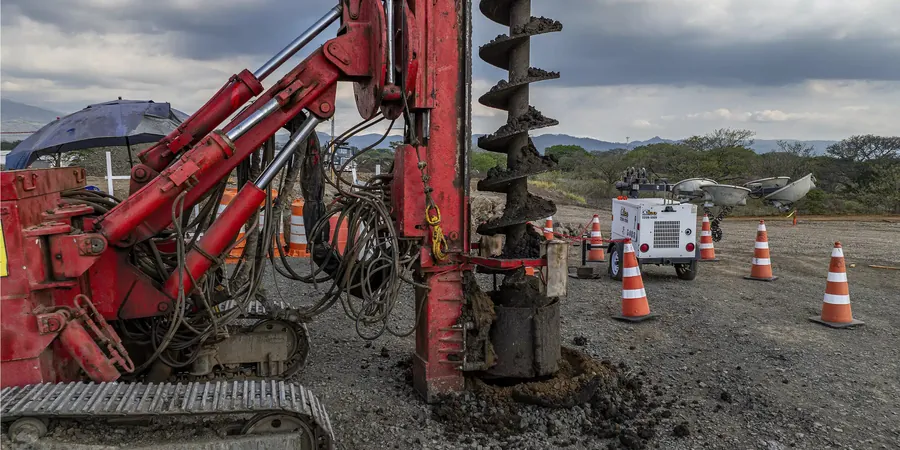
A hydraulic vibrator with a 130-ton clamp force drives the casing into the ground at a Dallas infill site. The operator watches the ammeter and penetration rate: a sudden drop in current means a soft lens, maybe organic silt from an old creek bed that was covered during 1970s grading. Incomplete penetration through that layer leaves a bulge that shortens the column's effective length. The bigger risk in Dallas is not the clay—it is the unknown. Abandoned utility trenches, old pier foundations, and uncompacted fill can deflect the probe or create zones where lateral confinement is insufficient. We cross-reference historical aerial photos and Sanborn maps when available, and we run an SPT drilling program on a tighter grid in suspected fill areas before finalizing the stone column layout. Without that step, you risk differential settlement that defeats the purpose of ground improvement.
Applicable standards
IBC Chapter 18 – Soils and Foundations, ASCE 7 – Minimum Design Loads for Buildings, ASTM D1586 – SPT for penetration resistance, ASTM D2487 – Soil classification for geotechnical profiling
Associated technical services
Feasibility & Settlement Analysis
Priebe method and finite element models to estimate composite modulus and total settlement under column and raft loading, calibrated to Dallas formation properties.
Vibro-Replacement Design
Column diameter, spacing, and depth layouts for wet top-feed or dry bottom-feed rigs, with aggregate specs matched to ASTM D448 gradations.
Load Test Verification
Full-scale modulus tests and zone load tests on production columns to confirm design assumptions before structural concrete is placed.
Construction-Phase QA/QC
Real-time monitoring of amperage, depth, and stone consumption during installation, plus post-installation CPT or SPT verification per project specification.
Typical parameters
Frequently asked questions
How much does stone column design cost for a Dallas building project?
Design fees for stone column ground improvement in the Dallas area typically range from US$1,350 for a straightforward single-story slab on grade up to US$4,500 for a multi-story structure requiring settlement analysis, liquefaction evaluation, and load test specification. The final number depends on column count, depth, and the extent of pre-design site investigation needed.
Are stone columns effective in Dallas Blackland Prairie clay?
Yes, when designed correctly. The high-plasticity clays of the Eagle Ford and Taylor formations provide adequate lateral confinement once the column displaces and densifies the surrounding soil. The key is extending the column below the active moisture fluctuation zone—typically 15 to 18 feet in Dallas—to avoid seasonal heave and shrinkage at the column tip.
What site investigation is required before stone column design?
A minimum of SPT borings on a 50-foot grid, classification testing per ASTM D2487, and Atterberg limits for cohesive strata. In areas near the Trinity River or mapped fill zones, we recommend supplemental CPT soundings to catch soft lenses that could reduce lateral confinement. Historical aerial photo review helps identify former creeks or borrow pits now covered by development.