A 15-story tower near the Trinity River corridor hit a snag during foundation design. The borings showed stiff clay but the dynamic response was unclear. We deployed a combination of MASW and downhole seismic to map the shear wave velocity profile across the site. Dallas sits on sedimentary formations with variable stiffness—Eagle Ford Shale, Austin Chalk, and alluvial deposits in the floodplain. Site class can shift from C to D within 200 feet. That matters for the base shear calculation. The CPT test provides continuous tip resistance and pore pressure data needed to refine the Vs30 profile, while grain-size analysis confirms the fines content for liquefaction screening per NCEER methodology.
Site class in Dallas can shift from C to D within a single city block when the Eagle Ford Shale pinches out against alluvial clays.
Methodology and scope
Local considerations
ASCE 7-22 Section 11.4.8 requires a site-specific ground motion analysis for structures on Site Class D with S1 above 0.2g, and for any Site Class E or F condition. In Dallas, the S1 value at the 2,475-year return period is approximately 0.15g according to the USGS hazard maps, which places many projects in a gray zone where the code default coefficients may be unconservative. The biggest risk we encounter is a uniform-hazard spectrum that underestimates spectral acceleration at periods between 0.5 and 1.5 seconds. That is exactly the period range for mid-rise buildings. A microzonation study that ignores the impedance contrast between the stiff upper clays and the softer weathered shale below 40 feet will miss the amplification peak. We have back-analyzed ground motions from the 2014 Venus earthquake sequence and found site amplification consistent with basin-edge effects along the White Rock Escarpment. Ignoring these local effects means designing for a seismic demand that is 30% lower than what the site will actually experience.
Applicable standards
ASCE 7-22 Minimum Design Loads for Buildings and Other Structures, IBC 2021 Section 1613 Earthquake Loads, ASTM D7400-19 Standard Test Methods for Downhole Seismic Testing, NCEER 1997 Liquefaction Resistance of Soils (Youd-Idriss methodology), ASTM D5778-20 Standard Test Method for CPT
Associated technical services
Vs30 Mapping and Site Classification
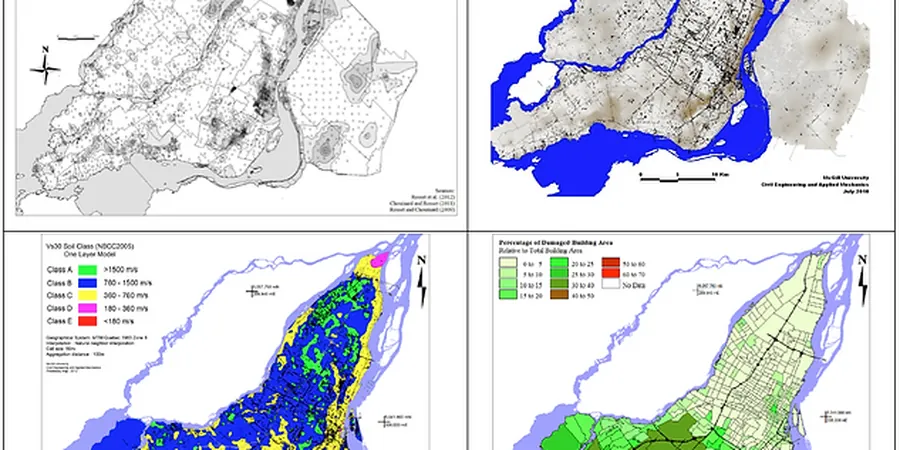
Multi-line MASW surveys combined with CPT soundings and downhole seismic to map shear wave velocity across the site. We deliver a contour map of Vs30, the site class per ASCE 7 Chapter 20, and the design coefficients SDS and SD1 for each building footprint.
Site-Specific Response Spectrum
One-dimensional equivalent-linear site response analysis using DEEPSOIL or SHAKE2000. Input motions are selected from the PEER NGA-West2 database and scaled to the target uniform hazard spectrum. Output includes surface acceleration time histories, response spectra at 5% damping, and amplification factors for the structural model.
Typical parameters
Frequently asked questions
When is a site-specific seismic study required in Dallas?
A site-specific study is mandatory under IBC 2021 when the site is classified as Site Class F, or when ASCE 7-22 Section 11.4.8 triggers it. In Dallas, this commonly applies to sites with soft clay deeper than 40 feet, loose alluvial sands in the Trinity River floodplain, or any condition where the mapped spectral accelerations are near the code thresholds. The study must include a ground motion hazard analysis and site response analysis per Section 21.2.
What is the difference between MASW and downhole seismic for Vs profiling?
MASW is a surface wave method that produces a 2D Vs cross-section quickly and non-invasively. It works well in Dallas clays where the stiffness increases gradually with depth. Downhole seismic requires a borehole and measures the direct arrival time between a surface source and a borehole receiver, giving a more precise Vs profile at a single point. We run both because MASW can miss a thin high-velocity layer that downhole will capture, and downhole alone does not show lateral variability.
What does a microzonation study cost in the Dallas area?
For a typical commercial site in Dallas, a microzonation study ranges from US$4,630 to US$16,630 depending on acreage, number of MASW lines, depth of investigation, and whether CPT or borings are included. A 2-acre site with 4 MASW lines, 2 downhole tests, and 4 CPT soundings typically falls in the middle of that range. The final cost depends on site access conditions and the required deliverables for the building permit.