The survey crew sets up the total station near White Rock Lake while the drill rig advances a hollow-stem auger through stiff Dallas clay. Retaining wall design here starts with understanding what lies beneath the surface—the Eagle Ford Shale and Taylor Marl formations that dominate the local geology. A proper retaining wall design sequence integrates subsurface exploration, laboratory testing, and load calculations that account for the expansive nature of North Texas soils. Our team coordinates the drilling, sampling, and analysis so that each retaining wall design reflects actual site conditions rather than generic assumptions. The process moves from field data to triaxial testing when drained shear strength parameters are needed for clayey backfill, and to grain-size analysis when backfill material selection requires precise gradation curves to ensure adequate drainage behind the wall.
Proper retaining wall design in Dallas clay requires drained strength parameters—peak and residual—because progressive failure along pre-existing slickensides can reduce the factor of safety over time.
Methodology and scope
Local considerations
North Texas weather swings from prolonged drought to intense spring thunderstorms that can drop three inches of rain in a few hours, saturating the clay and triggering hydrostatic pressure buildup behind walls. A retaining wall design that ignores these extremes risks bulging, cracking, or complete collapse within a few seasonal cycles. The Dallas clay shrinks during summer, opening fissures that become preferential pathways for water infiltration when rains return—a cycle that accelerates deterioration of unreinforced masonry walls and undermines shallow footings. We address this by specifying continuous drainage blankets, perforated collector pipes with cleanouts at each end, and free-draining backfill extending at least eighteen inches from the wall face. Where the wall retains a slope steeper than 2:1, we run limit-equilibrium analyses using residual strength parameters to confirm that progressive failure will not propagate through the retained zone over the design life of the structure.
Applicable standards
IBC 2021 (Chapter 18: Soils and Foundations), ASCE 7-22 (Minimum Design Loads, Section 11.8 Earth Pressures), ASTM D698-12 (Standard Proctor Compaction), ASTM D4767-11 (Consolidated-Drained Triaxial), AASHTO LRFD Bridge Design Specifications (Section 11: Abutments and Retaining Walls)
Associated technical services
Cantilever and Gravity Wall Design
Reinforced concrete cantilever and gravity wall sections designed for Dallas expansive clay conditions. Includes bearing capacity verification on Eagle Ford Shale or Austin Chalk, sliding and overturning checks per IBC, and drainage detailing with filter fabrics and gravel blankets.
MSE and Modular Block Wall Support
Mechanically stabilized earth walls and segmental block systems evaluated for local backfill compatibility. We test select fill for electrochemical properties (resistivity, pH, chlorides) to prevent reinforcement corrosion, and specify geogrid lengths based on internal stability analysis.
Typical parameters
Frequently asked questions
What retaining wall types work best in Dallas expansive clay?
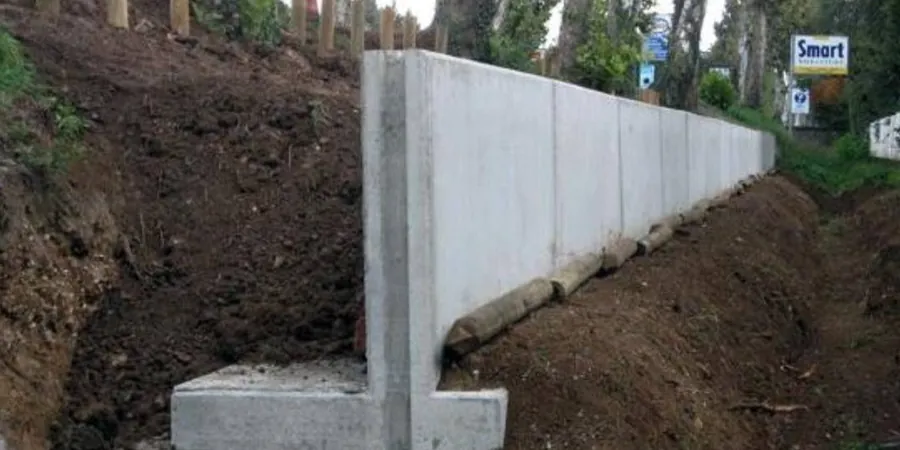
Cantilever reinforced concrete walls on drilled piers socketed into stable shale or limestone perform best because they isolate the wall from shallow heave movements. Segmental block walls (MSE) can also work well when backfill is select low-plasticity material and drainage is detailed carefully. Gravity walls are generally limited to heights under four feet unless founded on rock. The key is keeping water away from the foundation and using flexible joints that tolerate some differential movement.
How much does retaining wall design cost in Dallas?
Geotechnical investigation and retaining wall design for a typical residential wall (4–8 feet high) in the Dallas area ranges from US$1,140 to US$4,410, depending on wall length, access constraints, and whether laboratory testing is needed. Commercial walls with taller sections or surcharge loads fall toward the upper end. The fee covers site investigation, laboratory testing, design calculations, and a stamped report.
Does every retaining wall over 4 feet need a permit in Dallas?
Yes. The City of Dallas requires a building permit for retaining walls exceeding 4 feet in height measured from the bottom of the footing to the top of the wall. Walls supporting a surcharge (driveway, building) or located in a floodplain may require permits even at lower heights. A geotechnical report with retaining wall design calculations must accompany the permit application, stamped by a Texas-licensed professional engineer.
How long does the retaining wall design process take from start to finish?
A typical residential retaining wall design in Dallas takes 2 to 3 weeks from field investigation to stamped report. Week 1 covers drilling, sampling, and laboratory testing (classification, shear strength, compaction). Week 2 covers analysis and drafting. Week 3 allows for internal review and coordination with the structural engineer and architect. Rush turnaround is available for projects with tight construction schedules.