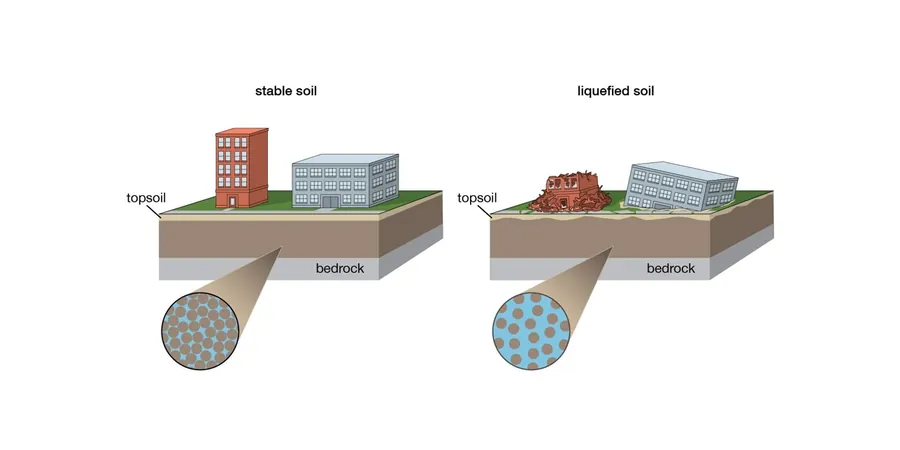
Build on the Blackland Prairie clays near White Rock Lake and you will find a different world than the sandy terraces along the Trinity River corridor in West Dallas. The former holds stiff, expansive fat clays; the latter can hide loose, saturated silty sands just a few feet below grade. That contrast is exactly why a targeted soil liquefaction analysis matters here. Our lab team has processed hundreds of split-spoon samples from across Dallas County, and the data shows that liquefiable layers tend to appear in pockets — not everywhere — mostly in Holocene alluvium and older fluvial deposits where the water table sits shallower than 20 feet. A routine boring log alone will not flag the risk: you need cyclic stress ratio calculations, fines-content corrections per Seed and Idriss, and a solid understanding of local stratigraphy to separate real hazard from regulatory checkbox. When a site falls within the Trinity River floodplain or near a relict channel, we pair the SPT data with grain-size analysis to confirm whether the material is truly susceptible to flow failure under seismic loading.
A single sieve test showing 18% fines can shift the liquefaction factor of safety from 0.8 to 1.3 — the difference between stone columns and a standard mat foundation.
Methodology and scope
Local considerations
Dallas grew fast along the Trinity River floodplain, and many industrial parcels and older commercial strips sit on Holocene alluvium that was never engineered for the seismic demand we recognize today. While North Texas is not California, the USGS hazard maps assign a non-trivial 2% probability of exceedance in 50 years for short-period shaking — enough to trigger liquefaction in loose, saturated sands if the fines content is low and drainage is constrained. The cost of ignoring this analysis shows up later: differential settlement after a moderate event, cracked slabs in tilt-wall warehouses, or a detained certificate of occupancy because the building official asks for a liquefaction study that was skipped during design. Our soil liquefaction analysis gives the structural engineer defensible numbers — post-liquefaction volumetric strain, residual strength, and allowable bearing pressure under seismic conditions — so foundation decisions are not made on guesswork. For sites where the risk is marginal, we often recommend a CPT test to get a continuous resistance profile without sample disturbance, which can refine the factor of safety enough to avoid unnecessary over-excavation or costly vibro-replacement.
Applicable standards
NCEER Workshop (Youd, Idriss et al., 2001) — Simplified procedure for liquefaction evaluation, ASTM D1586-18 — Standard Test Method for Standard Penetration Test (SPT), ASCE 7-22 — Minimum Design Loads and Associated Criteria (site classification & PGA), IBC 2021 Section 1803 — Geotechnical Investigations (liquefaction assessment requirements), Seed & Idriss (1971, 1982) — Cyclic stress ratio and fines correction basis
Associated technical services
SPT Energy Calibration and Soil Sampling
We deploy automatic trip hammers with instrumented rods to measure energy transfer ratio per ASTM D4633, delivering corrected N60 values rather than raw blow counts. Split-spoon samples are logged under the supervision of a licensed geologist who understands the Dallas stratigraphic column.
Index and Fines Characterization Laboratory
Full grain-size distribution via sieve and hydrometer, Atterberg limits, and #200 wash in our Dallas lab. These numbers feed the liquefaction susceptibility criteria and are reported within 48 hours of sample receipt for time-sensitive foundation redesigns.
Deterministic and Probabilistic Liquefaction Report
We calculate cyclic stress ratio, cyclic resistance ratio, and factor of safety for each critical layer using both the NCEER deterministic method and a Monte Carlo probabilistic approach. The output includes post-liquefaction settlement estimates and residual strength for pile design.
Typical parameters
Frequently asked questions
Is a soil liquefaction analysis mandatory for my Dallas building permit?
Under IBC 2021 Section 1803, a geotechnical investigation must assess liquefaction potential when the site class is D, E, or F and the mapped PGA exceeds 0.10g — which applies to most of Dallas County. The building official will typically request the liquefaction study if your foundation design relies on shallow footings and the boring logs show saturated, loose granular soils within 50 feet of grade.
How much does a soil liquefaction analysis cost for a typical Dallas commercial site?
For a standard commercial lot in Dallas, a complete liquefaction analysis — including SPT drilling, laboratory index testing, and the engineering report — typically falls between US$2,560 and US$4,590. The final cost depends on the number of borings, the depth of the liquefiable layer, and whether CPT soundings are added to refine the factor of safety.
Can you reuse existing SPT data from a previous geotechnical report?
Sometimes yes, but we need to verify the hammer energy efficiency and the drill rig type used. Older Dallas reports often lack calibrated N60 values, which means the raw blow counts could be off by 20 to 30 percent. We can re-run the analysis with correction factors if the soil descriptions, fines content, and water table observations are documented well enough to support a defensible factor of safety calculation.