The geotechnical difference between a site in Uptown and one out in Mesquite can be night and day. In Uptown you might hit the competent Austin Chalk within a few feet, a rock that holds vertical cuts remarkably well. Head east across the Trinity River and you are deep into the expansive clays of the Blackland Prairie. The Eagle Ford formation here weathers into a material notorious for its shrink-swell potential, and in our experience, that same plasticity is what drives most shallow slope failures after a wet spring. A sound slope stability analysis in Dallas starts with recognizing exactly which formation you are standing on, because the failure mechanisms on chalk are structurally controlled while on weathered shale they are pore-pressure driven.
On the weathered Eagle Ford of Dallas, a 10% rise in moisture can halve your factor of safety. Drainage isn't an accessory here; it's the primary design element.
Methodology and scope
Local considerations
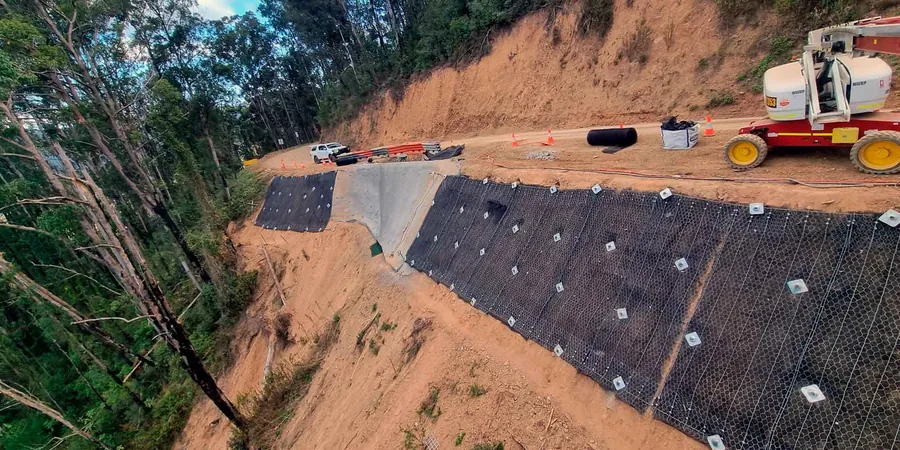
When we mobilize a track-mounted CME-75 drill rig to the site, the first thing the crew checks is the slope of the access path. We have seen too many rigs nearly tip on a 15-degree incline in wet clay. The biggest risk in Dallas is not a catastrophic landslide, but a slow, creeping failure on a residential cut slope that goes unnoticed until the pool deck cracks. Ignoring a proper analysis on a 12-foot cut in White Rock Creek area can lead to a repair bill that dwarfs the original study cost. The expansive nature of the local clay means the soil itself works against you: it shrinks in the summer drought, opening tension cracks at the crest, and then swells shut in the fall rains, trapping water and building hydrostatic pressure. That cycle of cracking and swelling is what triggers most shallow translational slides here, and it is precisely what our limit equilibrium models are calibrated to catch.
Applicable standards
ASTM D4767 (Consolidated Undrained Triaxial), ASTM D4318 (Atterberg Limits), IBC Chapter 18 (Soils and Foundations), ASCE 7-22 (Seismic Loading), FHWA-NHI-05-123 (Soil Slope and Embankment Design)
Associated technical services
Global Limit Equilibrium Modeling
We build 2D models in Slide2 or SLOPE/W using laboratory-measured strength parameters from Shelby tube samples. Each model includes the seasonal perched water table we observe across Dallas County, so the output is a realistic worst-case scenario, not just a textbook exercise.
Cut and Fill Optimization
For subdivisions in the Cedar Hill or Grand Prairie areas where topography is rolling, we evaluate the economic trade-off between flattening a slope and adding retaining elements, always tied to the local excavation cost per cubic yard.
Typical parameters
Frequently asked questions
How much does a slope stability analysis cost for a typical Dallas residential lot?
For a single-lot analysis on a slope under 20 feet high, you are generally looking at a range between US$1,300 and US$3,980. The spread depends on whether we need to bring in a drill rig to get undisturbed samples of the Eagle Ford shale, or if we can base the analysis on existing geotechnical data from nearby sites.
What is the minimum factor of safety required by the city of Dallas for a permanent cut slope?
The city of Dallas follows IBC Chapter 18, which requires a minimum static factor of safety of 1.5 for permanent slopes. If the slope supports a structure or roadway, the geotechnical report must demonstrate this with a peer-reviewed limit equilibrium analysis.
Why do shallow slides happen so often in the Blackland Prairie clays?
Those clays are highly plastic, with liquid limits often above 50%. During the Texas summer, they desiccate and crack open; when the heavy October rains come, water fills those cracks and gets trapped by the swollen surface soil, creating a perched water table with high pore pressure just a few feet down. That slickensided zone becomes the failure surface.
Do you need to include seismic loading in a Dallas slope stability analysis?
Yes. Dallas County is in a low-to-moderate seismic zone, but the IBC still requires a pseudo-static analysis with a horizontal acceleration coefficient. We typically use a kh value between 0.05 and 0.10, which often controls the design when the static factor of safety is already marginal.
How long does the analysis take from start to finish?
If we are handling both the field investigation and the lab testing in our Dallas facility, a complete analysis with a signed report can be turned around in two to three weeks. Time-sensitive projects can be expedited, but the triaxial testing on saturated clay specimens has a fixed consolidation phase that cannot be rushed.