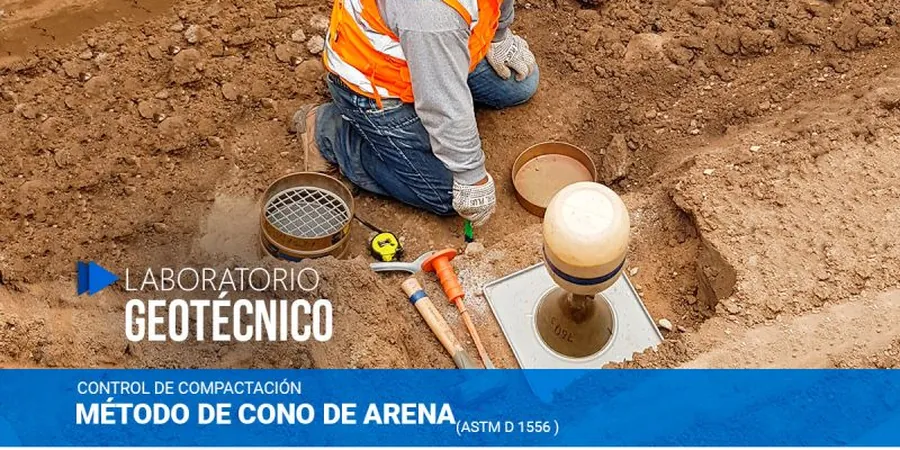
A few years back, we were called out to a warehouse pad site near I-20 in southern Dallas where the contractor had just placed over 18 inches of select fill in a single lift. The spec called for 95% modified Proctor, but the first few sand cone tests came back in the high 80s. You could feel the give under your boot. After that, they reworked the lift in 8-inch increments with moisture conditioning, and the numbers finally lined up. That’s the reality of earthwork in the Blackland Prairie: the fat clays here don’t forgive shortcuts. The field density test using the sand cone method (ASTM D1556) remains the most practical way to verify compaction on active job sites around Dallas, whether for building pads, roadway subgrade, or trench backfill. It pairs naturally with a Proctor test to establish the reference curve and with Atterberg limits when the material’s plasticity raises questions about moisture sensitivity during compaction.
A single sand cone test on a 5,000-square-foot lift tells you more about compaction uniformity than a week of guesswork.
Methodology and scope
Local considerations
Dallas sits on a geologic boundary: north of I-30 you get the weathered shale and limestone of the Eagle Ford and Austin Chalk formations, while south and east you’re deep in the Taylor Marl and Blackland Prairie clays—some of the most expansive and moisture-sensitive soils in the country. That contrast creates a compaction verification challenge that doesn’t exist in sandier parts of Texas. A fill that passes density on a hot August afternoon can lose significant strength after an overnight thunderstorm if the clay swells and the density drops below spec before the next lift goes down. We’ve seen this repeatedly on residential subdivision pads in Collin County and on commercial sites in the Design District, where tight schedules push earthwork into marginal weather windows. The sand cone test provides a point measurement, not a profile, so its reliability depends on test frequency and placement—something the IBC and local building officials in Dallas County enforce through minimum testing rates per lift and per 2,500 square feet of compacted area.
Explanatory video
Applicable standards
ASTM D1556 Standard Test Method for Density and Unit Weight of Soil in Place by the Sand-Cone Method, TxDOT Tex-115-E Field Method for Determining In-Place Density of Soils and Base Materials, ASTM D698 Standard Test Methods for Laboratory Compaction Characteristics of Soil Using Standard Effort, IBC Chapter 18 Soils and Foundations (acceptance criteria for compacted fill)
Associated technical services
In-Place Density by Sand Cone (ASTM D1556)
On-site density testing of compacted fill, subgrade, and trench backfill using the calibrated sand cone apparatus. Each test includes moisture content determination and percent compaction calculation against the project’s Proctor curve. We test at the frequency required by the geotechnical report or Dallas building code, typically one test per lift per 2,500 ft².
Compaction Curve Correlation and Fill Acceptance Reports
Lab-compacted Proctor curves (standard or modified) matched to the on-site fill material, plus signed field reports showing dry density, moisture, and percent compaction for each sand cone test. Reports are formatted for direct submittal to the engineer of record and Dallas permitting authorities.
Typical parameters
Frequently asked questions
How much does a sand cone density test cost on a Dallas earthwork project?
For most Dallas-area sites, a single field density test using the sand cone method runs between US$90 and US$140 per point, assuming reasonable access and standard travel within the metro area. The unit rate drops when we schedule multiple tests on the same day or combine density testing with other lab and field services.
How many sand cone tests are required per lift on a commercial building pad?
The geotechnical report normally specifies the minimum frequency, but as a rule of thumb Dallas-area engineers require one test per 2,500 square feet per lift, with no fewer than four tests on any single lift. The IBC and local jurisdiction in Dallas County also set minimums that depend on the type of fill and the consequence of settlement.
Can the sand cone method be used on crushed limestone base or gravelly fill?
ASTM D1556 works best when the maximum particle size is under 1.5 inches. If the base course contains larger limestone fragments or chert gravel—common in Dallas commercial and roadway projects—the test hole becomes distorted and the sand volume measurement loses accuracy. In those cases we often switch to a nuclear gauge or, when the spec allows, correlate a few sand cone tests with a larger-volume water replacement method.
What happens if a sand cone test fails to meet the specified compaction?
When a test comes in below the required percentage—say 92% compaction on a 95% spec—the typical corrective action on a Dallas site is to rework the lift: scarify, moisture-condition, and recompact, then retest. The engineer of record may also require additional tests in the surrounding area to confirm that the low density is isolated and not a systematic problem across the fill.