Dallas sits on the Blackland Prairie, where the soils are anything but predictable. The Upper Cretaceous Eagle Ford shale weathers into highly plastic, expansive clay that swells with spring rain and shrinks hard during the hundred-degree August drought. Any geotech who has worked along the Trinity River corridor knows that standard SPT blow counts can mislead you when the clay is saturated. That is why more structural engineers in Dallas now specify the CPT test for sites east of US-75, where the Taylor Marl transitions into the Woodbine formation. The cone penetrometer gives a continuous profile of tip resistance and sleeve friction, revealing thin sand seams and slickensided clay zones that a split-spoon sampler simply misses. Pairing CPT data with a few test pits for visual logging on the same lot gives us a ground model that holds up under the IBC Chapter 18 requirements.
A CPT trace through Dallas expansive clay reads like a biography of the soil: crust, moisture front, parent shale, all in one continuous log.
Methodology and scope
Local considerations
A mid-rise apartment complex near the Bishop Arts District taught us a lesson about skipping CPT in Dallas. The geotechnical report relied on borings spaced 150 feet apart and missed a 3-foot sand seam at 22 feet depth within the Eagle Ford formation. During excavation, groundwater migrated laterally through that seam and destabilized the shoring wall on the south side of the cut. The contractor lost three weeks and spent extra on dewatering and soil nails. With a CPTu sounding at every column line, the continuous sleeve friction trace would have caught that drainage path immediately. The soil behavior type index (Ic) would have flagged the contrast between the clay and the sand, and the pore pressure spike during dissipation would have confirmed the perched water. Nobody in Oak Cliff or East Dallas wants to be the next case study.
Explanatory video
Applicable standards
ASTM D5778-17: Standard Test Method for Electronic Friction Cone and Piezocone Penetration Testing of Soils, ASTM D2487-17: Standard Practice for Classification of Soils for Engineering Purposes (Unified Soil Classification System), IBC 2021, Chapter 18: Soils and Foundations, with Dallas amendments, Robertson (1990) Soil Behavior Type (SBT) classification system, updated SBTn (2016)
Associated technical services
Standard Piezocone Sounding (CPTu)
Electric cone with 15 cm² tip area, u2 filter at the shoulder. We log tip resistance, sleeve friction, and dynamic pore pressure at 1 cm depth intervals. Includes friction ratio and Bq pore pressure ratio plots. Ideal for foundation bearing evaluation in the expansive clays of Dallas, Collin, and Denton counties.
Seismic Cone (SCPTu) with Shear Wave Velocity
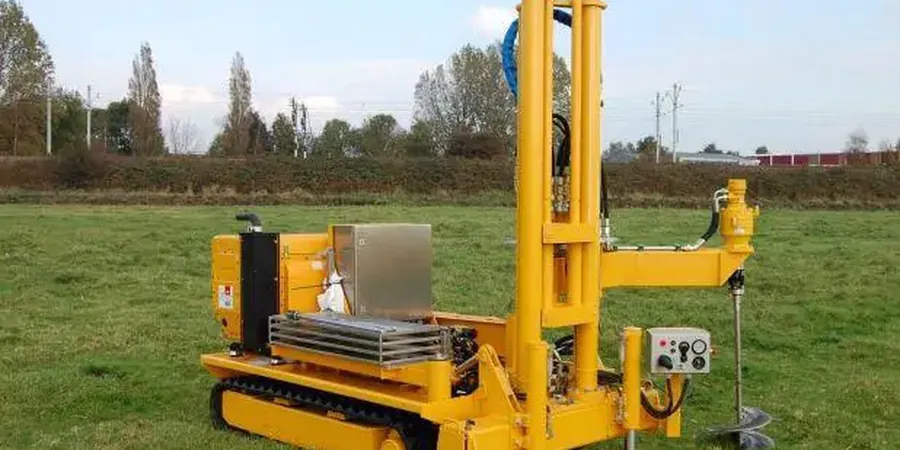
Standard CPTu rig with a triaxial geophone module added behind the cone. At designated depths we stop the push, trigger a surface shear wave source, and record the wave travel time directly. This gives us a true interval Vs profile for site class determination per ASCE 7, without the inversion assumptions of surface MASW.
Typical parameters
Frequently asked questions
How deep can a CPT rig push in Dallas clay and shale?
In the typical Dallas profile — stiff fat clay over weathered Eagle Ford shale — our 20-ton rig can reach between 40 and 65 feet before hitting practical refusal at around 20 MPa tip resistance. Depth in the alluvial deposits along the Trinity River can exceed 80 feet, where the sand and soft clay offer less resistance.
What does a CPT test cost for a residential lot in Dallas?
For a standard single-family lot in Dallas, a CPTu sounding typically runs between US$170 and US$230 per sounding, assuming reasonable access and mobilization within the metro area. The final number depends on how many soundings the structural engineer specifies and whether seismic cone or dissipation tests are required.
Can CPT data be used to design slab-on-grade foundations in expansive soil?
Yes, and it is becoming the preferred method among Dallas structural engineers. The continuous tip resistance and sleeve friction traces allow the geotechnical engineer to identify the depth of the active moisture zone, quantify the undrained shear strength of the clay, and estimate the swell pressure potential using correlations with the CPT soil behavior type index.