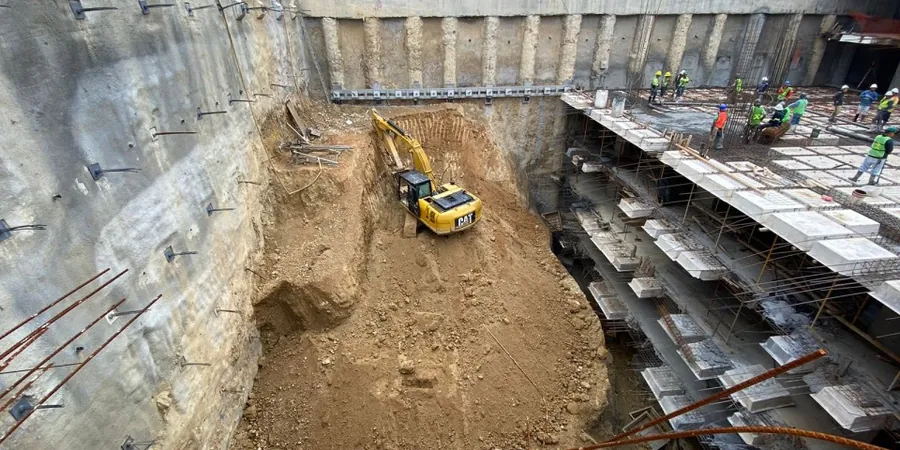
A common mistake in Dallas construction is treating a 30-foot basement excavation in the Eagle Ford Formation with the same shoring strategy applied in Houston's softer Beaumont clays. The result can be costly: unexpected bottom heave, excessive wall deflection, or damage to adjacent structures along the Tollway corridor. The geotechnical design of deep excavations in this region demands a granular understanding of the Upper Cretaceous bedrock, which weathers rapidly upon exposure and transitions from rock-like to soil-like behavior in a matter of days. Our technical team integrates site-specific parameters—including joint orientation, moisture sensitivity, and surcharge loads from nearby high-rises—to develop braced cuts or tieback systems that remain stable through the full construction cycle. When slurry wall panels encounter the Austin Chalk or the Eagle Ford contact, the right retaining walls analysis becomes essential, as does correlation with slope stability evaluations for open-cut ramps in the northern suburbs.
In Dallas, the transition from weathered to intact Eagle Ford Shale can shift allowable bearing and lateral earth pressures by over 30 percent within a single vertical foot of excavation.
Methodology and scope
Local considerations
The Eagle Ford Shale underlying much of Dallas County contains thin bentonite seams and pyrite that oxidizes when exposed, generating sulfuric acid and sulfate-rich groundwater that attacks concrete and grout. An excavation left unsupported for even 72 hours after cutting through the weathered zone can develop slaking and raveling, compromising soldier pile embedment and increasing the risk of ground loss behind the wall. Another concern is the presence of the Woodbine Formation aquifer at depth; although many downtown excavations terminate above it, deeper shafts for transit or utility tunnels can encounter artesian pressures that induce basal instability if not properly weighted or dewatered. The combination of high summer temperatures—frequently exceeding 100°F—and expansive clay backfill around shoring systems accelerates shrinkage cracking and can open seepage paths parallel to walers and struts. A thorough geotechnical design of deep excavations in this environment includes sulfate durability specifications for shotcrete and cement grout, real-time inclinometer monitoring, and pre-construction condition surveys of all buildings within the zone of influence.
Applicable standards
ASCE 7-22 (Seismic earth pressures and load combinations), IBC 2021 Chapter 18 (Soils and foundations – excavation support), ASTM D1586-18 (Standard Penetration Test for subsurface characterization), ASTM D2487-17 (Unified Soil Classification for shale description), FHWA-NHI-10-024 (Earth Retaining Structures and shoring design)
Associated technical services
Braced and Tieback Excavation Design
Development of soldier pile and lagging, secant pile, or diaphragm wall sections with tieback anchor spacing and pre-loading schedules tailored to the Eagle Ford Shale's stress history and joint sets.
Urban Excavation Monitoring Plans
Instrumentation layouts including inclinometers, optical survey points, and vibration monitors for projects adjacent to DART tunnels and historic masonry structures in the Dallas downtown grid.
Typical parameters
Frequently asked questions
What is the typical cost range for a geotechnical design of deep excavations in Dallas?
For a mid-rise excavation in Dallas, the geotechnical design package—including subsurface exploration, laboratory testing, and shoring calculations—generally falls between US$2,120 and US$7,460, depending on depth, footprint size, and proximity to adjacent structures.
How does the Eagle Ford Shale affect excavation stability in Dallas?
The Eagle Ford Shale is a calcareous claystone that slakes rapidly when exposed to air and moisture. Design must account for strength degradation over the excavation stand-up time; we typically specify a maximum unsupported face duration and apply reduced shear strength parameters for the weathered zone in the structural analysis.
What shoring systems are most effective for deep excavations in the Dallas Central Business District?
Tieback-anchored soldier pile walls are common because they minimize internal obstructions, but where adjacent property easements restrict anchors, top-down construction with diaphragm walls or internal bracing is employed. The choice depends on the depth to the competent shale and the allowable lateral deflection under the surcharge of neighboring towers.