The subsurface conditions beneath a site in North Dallas can differ entirely from what you find down in the Trinity River floodplain. In neighborhoods like Preston Hollow, you might encounter stiff, overconsolidated Eagle Ford Shale, while a few miles south near the river, recent alluvial deposits dominate with silts and fine sands. Classifying these materials correctly is not optional when designing stormwater infiltration systems or deep foundations. Our grain size analysis service combines mechanical sieving for the coarse fraction and hydrometer testing for fines passing the No. 200 sieve. This dual approach provides the full particle-size distribution curve required for USCS classification per ASTM D2487. For sites where shallow bedrock is expected, pairing this with a test pit investigation ensures you capture the transition zone between residual soil and weathered rock accurately.
A complete gradation curve from 75 mm down to 0.001 mm reveals more about soil behavior than any single index test alone.
Methodology and scope
Local considerations
Dallas sits at an elevation ranging from about 380 to 750 feet above sea level, with a population exceeding 1.3 million, and sits within a region of moderate seismic hazard influenced by the Balcones Fault Zone. Misclassifying a silty clay as silt with sand can cascade into errors in bearing capacity calculations and pavement design. The biggest risk on Blackland Prairie sites is underestimating the clay fraction: a difference of just 5 percent more passing the No. 200 sieve can shift a soil from low to high expansion potential. For stormwater detention basins, an incorrect gradation analysis leads to infiltration rates that are either overly conservative or dangerously optimistic. In roadway projects, poor particle-size data causes premature failure of subgrade layers. The lab runs duplicate hydrometer tests when the coefficient of variation exceeds 6 percent, and all balances are verified with Class S weights before each batch. For large earthwork contracts, we recommend integrating grain size analysis with in-place density testing by sand cone method to correlate lab optimums with field compaction results.
Applicable standards
ASTM D422-63(2007)e2 – Standard Test Method for Particle-Size Analysis of Soils, ASTM D2487-17e1 – Standard Practice for Classification of Soils for Engineering Purposes (Unified Soil Classification System), ASTM D1140-17 – Standard Test Methods for Determining the Amount of Material Finer than 75-µm (No. 200) Sieve, AASHTO T 88 – Particle Size Analysis of Soils
Associated technical services
Mechanical Sieve Analysis
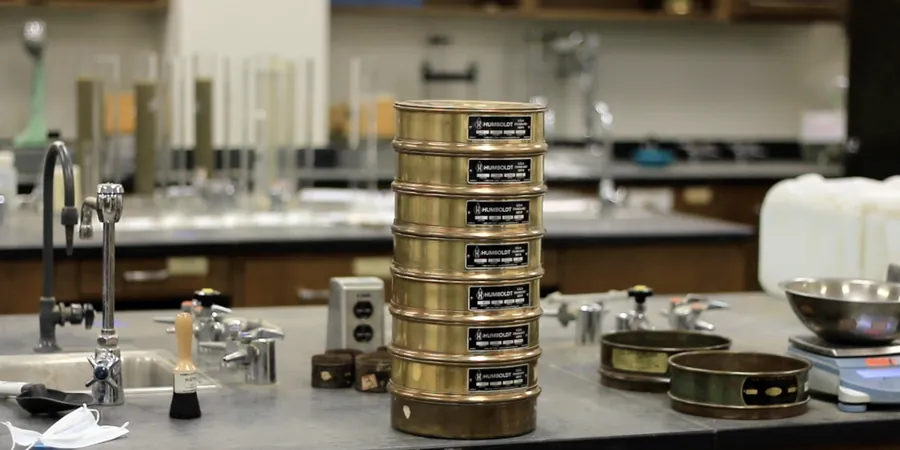
Covers the coarse and sand fractions using a stack of sieves from 75 mm (3 in) down to 0.075 mm (No. 200). The sample is oven-dried, pulverized with a rubber-tipped pestle, and shaken for 10 to 15 minutes. Results report percent retained on each sieve, cumulative percent passing, and the gradation curve for visual inspection. We wash the No. 200 sieve material to separate true fines before drying and weighing the retained fraction.
Hydrometer Analysis (ASTM D422)
Quantifies the silt and clay fraction for material passing the No. 200 sieve. A 50-gram specimen of oven-dried fines is mixed with a deflocculant and agitated in a dispersion cup. Hydrometer readings are taken over a 24-hour period with temperature correction applied. The computed particle diameters assume a specific gravity of 2.65 unless a pycnometer test indicates otherwise. The final report merges sieve and hydrometer data into a single continuous grain size distribution curve.
Typical parameters
Frequently asked questions
What is the difference between a washed sieve analysis and a dry sieve analysis?
A dry sieve analysis separates particles purely by mechanical shaking. A washed analysis passes water through the No. 200 sieve to remove clay and silt coatings from sand and gravel particles. In Dallas soils, which often contain cemented aggregates of calcium carbonate, the washed method gives a more accurate measure of the true fines content because it breaks down weak bonds that would otherwise retain fine material on coarser sieves. ASTM D1140 governs the washed procedure.
How much does a grain size analysis including hydrometer cost in Dallas?
For a combined sieve and hydrometer analysis following ASTM D422, the cost ranges from US$110 to US$180 depending on sample condition, the number of sieves required, and whether specific gravity determination is needed separately. A rush report with a 48-hour turnaround typically falls at the higher end of that range.
How long does it take to get results from a hydrometer test?
The hydrometer portion alone requires a minimum of 24 hours of sedimentation readings, plus an additional day for data reduction, plotting, and quality review. A full combined sieve and hydrometer report is typically delivered within three to four business days. Expedited service can be arranged for critical path projects.
Why is the hydrometer test necessary if I already have a sieve analysis?
The sieve analysis stops at 0.075 mm, but a significant portion of Dallas soils passes that boundary. The hydrometer extends the curve down to approximately 0.001 mm, capturing the clay fraction that governs shrink-swell potential, permeability, and cohesion. Without it, a soil with 60 percent clay could be misidentified as a low-plasticity silt, leading to underestimation of settlement and heave.