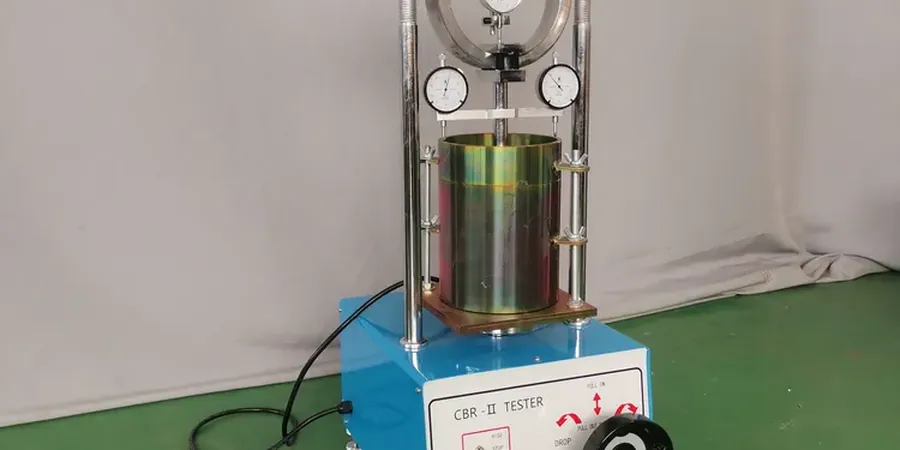
Dallas didn't just grow outward—it grew upward and over some of the most expansive clay formations in North Texas. The city's post-war highway boom, anchored by the Central Expressway in the 1950s, drove a construction rhythm that still demands rigorous subgrade evaluation. Today, whether it's a warehouse floor in the Inland Port or a parking structure in Deep Ellum, pavement longevity starts with a reliable CBR test for road design that reflects actual site conditions, not generic textbook values. The laboratory CBR test quantifies the bearing capacity of compacted soils under controlled moisture and density, giving engineers the soaked strength data needed to size base and asphalt layers correctly. In a region where summer heat bakes moisture out of clay and spring storms saturate the upper profile, knowing both the dry and soaked CBR values isn't optional—it's the difference between a pavement that lasts 20 years and one that fails after the first wet season. Our Dallas-based team runs CBR testing per ASTM D1883 and TxDOT TEX-113-E on samples collected from sites across the metroplex, from the Blackland Prairie soils of southern Dallas County to the sandy loam pockets found near the Trinity River levees.
A single soaked CBR value, properly correlated to local geology, can save more asphalt tonnage than any generalized design table ever will.
Methodology and scope
Local considerations
The Taylor Marl and Eagle Ford formations underlying much of Dallas County share a problematic trait: they lose significant strength when wetted. A compacted fill that tests at CBR 15 at optimum moisture can drop to CBR 3 or lower after soaking, which is why TxDOT specifications mandate soaked CBR values for pavement design. The risk isn't theoretical—Dallas averages 37 inches of rainfall annually, with intense May and October storm events that can saturate subgrade through pavement cracks, edge infiltration, and capillary rise from the fluctuating water table. If the laboratory CBR is based on field samples taken during a dry spell without proper moisture conditioning, the resulting pavement section will be dangerously undersized. We've seen parking lots in the I-35 corridor develop alligator cracking within three years because the design assumed a CBR of 8 based on unsoaked data, while the actual soaked value was closer to 3.5. The 96-hour soak in ASTM D1883 exists precisely to prevent this failure mode. For projects near the Trinity River floodplain, where groundwater can rise to within 3 feet of the surface after heavy rain, we also recommend supplementing CBR data with in-situ density and moisture checks to confirm that field compaction matches the laboratory benchmark.
Applicable standards
ASTM D1883 - Standard Test Method for California Bearing Ratio (CBR) of Laboratory-Compacted Soils, TxDOT TEX-113-E - Laboratory Compaction Characteristics and CBR of Soils, ASTM D698 / D1557 - Standard Proctor / Modified Proctor Compaction, ASTM D422 / D6913 - Particle-Size Analysis, ASTM D4318 - Atterberg Limits
Associated technical services
Soaked and Unsoaked CBR
Three-point compaction curve with CBR penetration at each point, tested as-compacted and after 96-hour soak. Includes swell monitoring and surcharge simulation.
CBR with Proctor Correlation
Paired testing that links maximum dry density and optimum moisture from ASTM D698 or D1557 directly to CBR values, giving the contractor a clear field compaction target.
Lime-Stabilized Subgrade CBR
CBR testing on lime-treated Dallas clays cured for 7 and 28 days to quantify strength gain. Essential for pavements on Taylor Marl where untreated CBR falls below 4.
CBR for Flexible and Rigid Pavement Design
Input parameters formatted for AASHTO 1993 and MEPDG design software, including resilient modulus estimates from CBR correlation and seasonal adjustment factors for North Texas.
Typical parameters
Frequently asked questions
What does a laboratory CBR test cost in the Dallas area?
A standard soaked CBR test on a single sample, including the Proctor compaction curve, typically ranges from US$140 to US$200. The total project cost depends on how many samples are needed—most pavement investigations require 3 to 5 CBR points per soil type to capture variability. We provide a per-sample breakdown before testing begins so there are no surprises.
How long does the CBR test take from sample delivery to report?
The full ASTM D1883 procedure requires 4 days of soaking plus compaction and penetration time. Including sample preparation, moisture content determination, and report generation, the typical turnaround is 5 to 7 business days. Expedited schedules can be arranged for projects with tight bid deadlines.
Why is the soaked CBR value lower than the unsoaked one?
Dallas clays contain smectite minerals that absorb water and expand, reducing density and inter-particle friction. The 96-hour soak forces this process to completion so the design CBR reflects the soil's weakest anticipated condition. In expansive Taylor Marl, it's common to see a 60-70% reduction from unsoaked to soaked CBR.
Can CBR values be correlated from other tests like the DCP or SPT?
Correlations exist—the N-value from an SPT drilling program can be converted to an approximate CBR using regional relationships, and Dynamic Cone Penetrometer (DCP) data can be correlated per ASTM D6951. However, these field correlations don't account for the controlled moisture and density conditions of a lab CBR. For final pavement design, TxDOT and most Dallas County jurisdictions require laboratory CBR values from compacted specimens.
What CBR value does Dallas require for residential streets?
Most Dallas-area municipalities follow TxDOT or North Central Texas Council of Governments (NCTCOG) standards, which specify a minimum soaked CBR of 6 for local residential streets and 10 or higher for collector and arterial roads. Subdivisions built on untreated expansive clay often require lime stabilization to reach these thresholds, and we test the stabilized mix to confirm the target CBR is achieved before pavement placement.