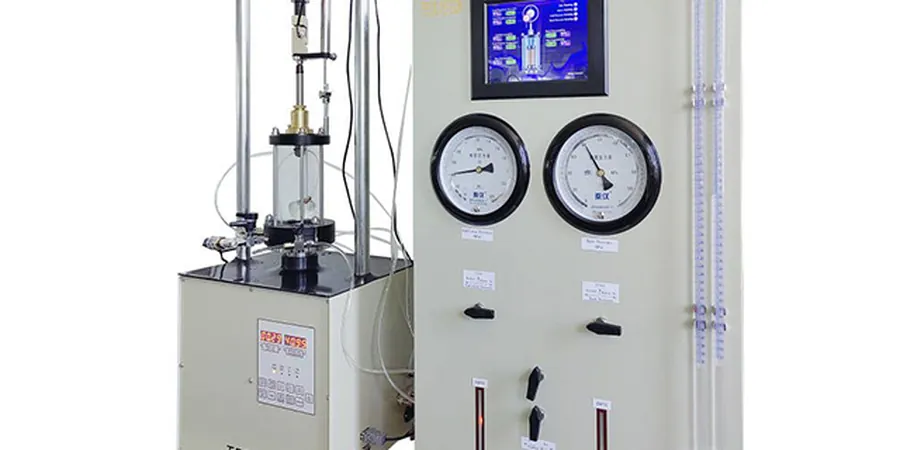
A triaxial cell sits inside a load frame inside a temperature-controlled lab near the Trinity River floodplain, where a cylindrical soil specimen—often trimmed from a Shelby tube sample extracted from the expansive clay formations common across Dallas—is sealed inside a latex membrane. Confining pressure is applied through water in the cell, simulating the in-situ stress state at depths ranging from 15 to 60 feet below grade. Axial load is then increased through a strain-controlled piston until shear failure occurs. This is the fundamental procedure behind the triaxial test, which provides the drained and undrained shear strength parameters that structural engineers rely on when designing deep foundations for high-rises in Uptown Dallas or retaining walls along the US-75 corridor. Unlike simpler index tests, the triaxial platform captures pore pressure response during shearing, a critical variable when evaluating saturated clay layers that are prevalent in the Blackland Prairie soils underlying much of the metro area. When a CPT test identifies a weak zone at depth, the triaxial data confirms whether that layer will govern the foundation design or if deeper bearing strata can be utilized without excessive settlement.
Effective stress parameters from a CIU triaxial test on Dallas clay often reveal friction angles 3 to 5 degrees lower than total stress estimates, a difference that directly impacts the calculated factor of safety.
Methodology and scope
Local considerations
A recurring observation from Dallas geotechnical reports is that unconfined compressive strength values for the Eagle Ford Shale can overestimate in-situ shear strength by 20 to 30 percent when the formation is fissured or contains slickensided surfaces. A single-stage triaxial test on an intact specimen may return a cohesion intercept of 1,500 psf, but back-analysis of slope failures in excavations near Mountain Creek Lake suggests that the operational strength along pre-existing discontinuities is often closer to 800 psf. The triaxial program must therefore be designed to test specimens at confining pressures that bracket the anticipated field stress range, and the failure envelope should be interpreted with careful attention to whether the specimen failed through intact material or along a pre-existing plane of weakness. In the expansive clay zones north of LBJ Freeway, the risk is compounded by seasonal moisture fluctuations that alter the effective stress state in the upper 15 feet. A drained triaxial test run at low confining pressure—simulating the condition after a prolonged summer drought—will show a higher shear strength than the same soil tested at the elevated pore pressures that follow a wet winter. This seasonal strength variation is a first-order input for retaining wall design where the backfill is native Dallas clay rather than imported select fill.
Applicable standards
ASTM D4767-11 (Consolidated Undrained Triaxial Compression Test for Cohesive Soils), ASTM D7181-20 (Consolidated Drained Triaxial Compression Test for Soils), ASTM D2850-15 (Unconsolidated Undrained Triaxial Compression Test), AASHTO T-297 (Consolidated Undrained Triaxial Test)
Associated technical services
Consolidated Undrained Triaxial (CU) with Pore Pressure
Isotropically consolidated specimen sheared at a controlled strain rate with continuous pore water pressure measurement, providing effective stress Mohr-Coulomb parameters for Dallas clay and shale formations where drainage during construction is negligible.
Consolidated Drained Triaxial (CD)
Slow shearing with open drainage to allow full pore pressure dissipation, suitable for granular alluvial lenses in the Trinity River floodplain and for long-term stability analysis of slopes in weathered shale.
Unconsolidated Undrained Triaxial (UU)
Rapid test for total stress parameters on cohesive specimens without saturation or consolidation stages, used as a screening tool for comparing undrained shear strength across multiple Shelby tube samples from a single Dallas borehole.
Cyclic Triaxial for Resilient Modulus
Repeated load testing under controlled stress levels to determine the resilient modulus (Mr) of subgrade soils for flexible and rigid pavement design on Dallas-area roadways, following the AASHTO T-307 protocol.
Typical parameters
Frequently asked questions
What is the typical turnaround time for a triaxial test program on a Dallas project?
A standard set of three consolidated undrained triaxial tests with pore pressure measurement, including specimen extrusion, trimming, back-pressure saturation, consolidation, and shearing, requires 12 to 16 working days from sample receipt to final report. Specimens from highly plastic Dallas clay may require extended consolidation stages due to low hydraulic conductivity, adding 2 to 4 days to the schedule. Expedited processing is available for time-sensitive foundation redesigns.
How much does a triaxial test cost for a project in Dallas?
The cost for a triaxial testing program typically ranges from US$2,170 to US$2,630, depending on the number of specimens per set, the confining pressure range, and whether drained or undrained conditions are specified. A complete set of three CU tests with pore pressure measurement and Mohr-Coulomb failure envelope interpretation falls within this range.
Which triaxial test type is most appropriate for the Eagle Ford Shale in Dallas?
A consolidated undrained triaxial test with pore pressure measurement is the standard approach for the Eagle Ford Shale, because this formation exhibits low permeability and significant pore pressure generation during undrained loading. The test provides both total and effective stress parameters, which are needed for short-term excavation stability analysis and long-term foundation design respectively.
How many triaxial specimens are needed for a Dallas high-rise foundation design?
The geotechnical investigation for a Dallas high-rise typically requires a minimum of three triaxial specimens per distinct soil unit within the depth of influence of the foundation. For a tower with a 60-foot influence zone encountering three distinct strata—fill, alluvial clay, and Eagle Ford Shale—the program would include at least nine specimens, with each stratum tested at three different confining pressures to define a reliable failure envelope.