Dallas rests on the Eagle Ford Shale and expansive clays of the Taylor Marl, formations notorious for their high plasticity and significant shrink-swell potential. With the region's active clay mineralogy, seasonal moisture fluctuations can induce ground movements exceeding four inches, placing conventional shallow footings at risk of differential settlement. A properly designed raft foundation distributes structural loads across a broad, stiffened plane, bridging local soft spots and resisting the edge-lift and center-lift distress patterns common across North Texas. SPT drilling provides the necessary subsurface data to calibrate the stiffness parameters used in our finite element models, ensuring the mat thickness and reinforcement layout are tuned to the actual stratigraphy encountered beneath your site.
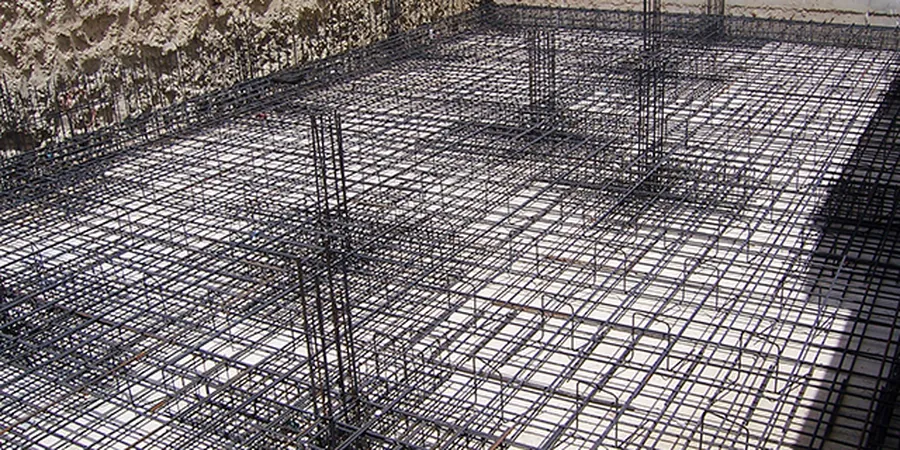
A stiffened raft foundation transforms the expansive clay challenge into a manageable engineering parameter, distributing differential movement across a controlled curvature.
Methodology and scope
Local considerations
The risk profile shifts noticeably between the weathered shale uplands of North Dallas and the alluvial terrace deposits along the Trinity River corridor. In areas like the Preston Hollow vicinity, shallow bedrock provides a stiff bearing stratum that limits long-term settlement, allowing a thinner mat with nominal reinforcement. Conversely, sites near the Trinity's floodplain often conceal pockets of soft, organic silt and loose sand lenses at depth, where a raft foundation without an integrated ground improvement strategy can experience excessive total and differential settlement. A common failure mode observed in under-designed slabs across Dallas County is edge lift, where the perimeter of the mat heaves upward relative to the interior during prolonged wet periods, cracking partition walls and jamming doors. Our design approach mitigates this by calculating the required beam depth and reinforcement ratio to resist the moment induced by a one-inch edge swell, as recommended by the Post-Tensioning Institute's DC10.5 criteria.
Applicable standards
ASCE 7-22 (Minimum Design Loads), IBC 2021 Chapter 18, ACI 318-19 (Structural Concrete), PTI DC10.5-19, ASTM D1586 (Standard Penetration Test), ASTM D4546 (Swell Pressure)
Associated technical services
Geotechnical Site Investigation
Drilling, sampling, and laboratory testing program to define the expansive clay profile, groundwater level, and bearing stratum characteristics for the mat foundation analysis.
Soil-Structure Interaction Modeling
Finite element analysis of the raft slab interacting with the supporting soil, accounting for stiffness degradation, swell pressure distribution, and superstructure rigidity.
Preliminary and Final Mat Design
Design of slab thickness, stiffening beam geometry, conventional or post-tensioned reinforcement layout, and under-slab moisture control systems.
Construction QA/QC Inspection
Field density testing of subgrade preparation, rebar placement verification, and concrete sampling during the mat pour to ensure compliance with the design documents.
Typical parameters
Frequently asked questions
How much does a raft foundation design cost for a commercial building in Dallas?
For a typical commercial project in the Dallas area, the fee for a complete raft foundation design package—including the geotechnical investigation, laboratory swell testing, and structural mat design—ranges from US$1,130 to US$4,540 depending on the building footprint, number of borings required, and complexity of the soil-structure interaction analysis.
Why is a raft foundation often recommended over isolated footings in Dallas?
The expansive clays of the Eagle Ford and Taylor Marl formations dominate the Dallas subsurface. These clays experience significant volume change with seasonal moisture fluctuations, which can cause differential movement between isolated footings. A raft foundation acts as a single stiff plate, distributing loads and bridging soft or heaving zones, reducing the risk of structural distress in the slab and frame.
What soil tests are needed before designing a mat foundation in North Texas?
The essential laboratory program includes Atterberg limits to quantify clay plasticity, swell-consolidation testing to measure the pressure exerted during wetting, and unconfined compression tests on shale samples. Field SPT borings are performed to log the stratigraphy and estimate the undrained shear strength profile, which feeds directly into the bearing capacity and settlement models.
How deep should the stiffening beams be on a Dallas raft foundation?
Beam depth is a function of the predicted edge-lift moment and the allowable deflection. For Dallas clays with a PI above 30, the Post-Tensioning Institute design methodology typically results in perimeter beams between 24 and 36 inches deep, with interior ribs proportioned to limit the differential deflection to less than 1/360 of the span under the design swell condition.
Can a raft foundation be combined with ground improvement in problematic Dallas soils?
In areas with deep, very soft clays or uncontrolled fill, it is common to combine a raft foundation with ground improvement techniques. For example, moisture conditioning the subgrade through injection or pre-swelling, or installing a geosynthetic-reinforced load transfer platform beneath the mat, can reduce the required slab thickness and improve long-term performance.