Dallas sits on the Eagle Ford shale and Taylor Marl formations, where active clays push seasonal volume changes past 4 inches in a single year. We have measured moisture-driven expansion at depths of 12 to 18 feet during droughts on sites near White Rock Creek, and that movement transfers directly into shallow footings if the design does not account for it. The IBC load path requires bearing capacity verification that blends ultimate failure with serviceability limits, and in this city that means controlling differential settlement to under three-quarters of an inch. For sites where the plastic clay layer is thinner, we often pair the shallow foundation analysis with a test pits program to log the contact between residual soil and weathered shale before sizing the footing width.
A shallow foundation in Dallas is not defined by the concrete strength; it is defined by the moisture regime of the clay within the first 15 feet.
Methodology and scope
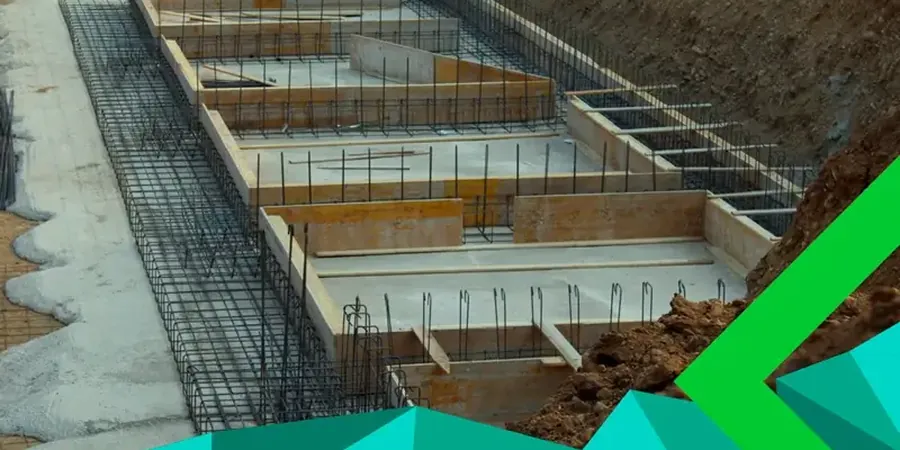
Local considerations
The most common mistake we see on Dallas projects is a contractor pouring strip footings at 18 inches depth in a highly expansive clay profile, then calling us six months later when the slab corners have lifted an inch and a half. The cost of a shallow foundation failure here is not just the crack repair; it is the litigation risk when the homeowner measures floor slopes beyond L/360. We have reviewed forensic reports where the original designer used a single 2,000 psf bearing value from a regional table without running swell-consolidation tests on the saturated clay, which violates the presumption of the IBC 2021 Chapter 18 provisions. In the Trinity River floodplain, add the risk of alluvial collapse upon wetting, where dry densities below 90 pcf can lose 10% of their volume under load with water infiltration.
Applicable standards
IBC 2021 Chapter 18 – Soils and Foundations, ASCE 7-22 – Minimum Design Loads for Buildings, ACI 318-19 – sulfate exposure classes for concrete, ASTM D2487 – Unified Soil Classification, ASTM D4546 – one-dimensional swell and collapse
Associated technical services
Spread footing and mat foundation design
Bearing capacity analysis with swell-consolidation coupling, including void-form specifications and moisture barrier details for the active clay zone.
Post-tensioned slab-on-grade engineering
Stiffness parameters from plate-load tests or CPT correlations, rib spacing and tendon layout calibrated to the expansive soil profile found across Dallas County.
Typical parameters
Frequently asked questions
What is the typical allowable bearing pressure for shallow foundations in Dallas?
There is no single number. On the Woodbine sand formations west of the city, we can justify 3,500 to 5,000 psf with a factor of safety of 3. In the Blackland Prairie clays, the allowable pressure often drops to 1,500 to 2,000 psf, and the design is governed by swell potential rather than shear failure. Every site needs a site-specific investigation per IBC 1803.2.
Do Dallas building codes require a geotechnical report for a single-family home?
The City of Dallas adopted the 2021 IBC with local amendments, and Chapter 18 requires a geotechnical investigation for all new buildings. For single-family residential, the report must address expansive soil classification, recommended foundation type, and any required moisture control measures. The city plan reviewer does not waive this requirement.
How do you handle the expansive clay problem in shallow foundation design?
We start with Atterberg limits and swell-consolidation tests on undisturbed samples from the active zone. If the swell pressure exceeds 2,500 psf, we typically specify a structural floor system with a ventilated crawl space or a post-tensioned slab with void forms underneath grade beams. We also design a perimeter moisture barrier and recommend landscape grading that drains away from the foundation.
What does a shallow foundation design study cost in Dallas?
For a typical single-family lot or small commercial site in Dallas, the combined field investigation and engineering report runs between US$1,970 and US$3,380. The final cost depends on the number of borings, laboratory testing scope, and whether we need to run swell-consolidation or collapsible soil tests.